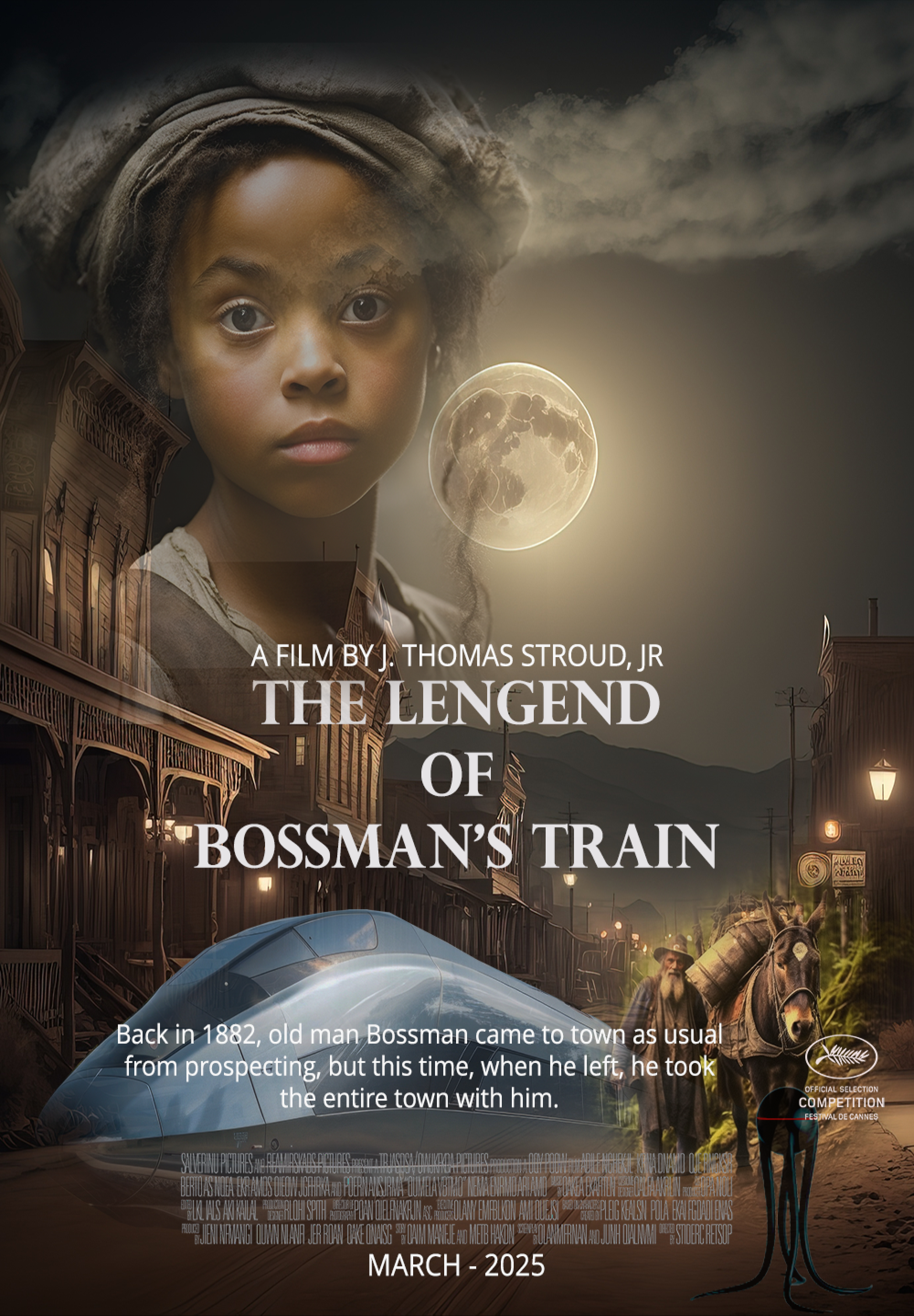
Synopsis/Details
The story begins with 124-year-old Nora Tremblay in a nursing home. Her great-granddaughter, Victoria Tremblay, is with her, along with writer and news reporter Brandon Peabody. Victoria leans in close to her aged Great grandmother and asks, "Great Nana, can you tell me that strange story again? The strange story of what happened to you when you were a little girl?"
The old Nora Tremblay begins to tell Victoria of the Spring, nearly 100 years ago, when her friend, Old Samuel Bossman, came down out of the Canadian Mountains. She tells Victoria she would wait all year for Bossman to come down. He would always be accompanied by his pack mule, Lola.
THE YEAR OF 1889 – SASKATCHEWAN OUTBACK, TOWN OF SPIRITWOOD:
My Grandma Millie didn't approve of Samuel Bossman. Ms. Millie Lefebvre adopted me when I was five years old from a Church organization back in Saskatchewan. No, Grandma thought Mr. Bossman was too uncouth. Besides my friend Tommy Michaud, Bossman was my only true friend. He didn't care that I was a native girl, as most of his friends in the outback were native people.
"Well," begins Old Nora, "that one year, that last year, Bossman came down, but things were different. He acted strange; he was scared of something, but I couldn't tell what he was scared of; none of us could until it was too late. He didn't have his normal gifts and homemade candies for us children. No, he was very different this time around."
Old Nora explains that Bossman wanted to see the town leader, James Gagnon. Bossman was so excited that he told everyone out loud that it was an emergency. He said he needed James' help with something, and he needed the entire town's help with something. Old Nora continued that old man Bossman made such a commotion that half the town filled out onto the main street to see what was happening.
"Yes," Old Nora continued, "Bossman was different. He was not his normal, happy, singing, self this Spring. He was scared to death of something. As I thought later," Old Nora added, "Maybe something happened to him up in them mountains?"
Constable Ned Brown calmed him down and told him Gagnon was out of town, but he had gone to Saskatchewan to the board of Electors for a meeting. After the Constable cleared the people away, he gave Bossman a half dollar and told him to go clean himself up and have a drink.
Old Nora added that when Bossman saw me, he calmed down a bit. I asked him if I could take care of Lola for him and bring her over to Vincent. Vincent Demers was the stable hand. This was my usual job when he came to town, Old Nora confided. Before she continues, Old Nora tries to lean forward in bed with the help of Victoria.
Settling back down in her soft bed, Old Nora continues. I will never forget the look in his eyes, the horror. He walked me a bit aways from Lola, grabbed me by both shoulders hard, and told me never to go near Lola while I was alone. He made me swear on our special promise.
Old Nora continued; "I will never forget that look on his face. It scared me more than anything."
Old Nora explained that Bossman was obsessed with getting the town ready for this special train he said was coming. That's what the whole town has been waiting on for years, and it was finally going to happen, that a railroad was coming to Spiritwood. The entire town threw a celebration in Samuel Bossman's honor and hailed him a town hero, but he still did not seem happy.
That first night, things started to happen, strange things. All the animals and pets started to disappear around the town—chickens, cats, and stuff like that. Then it was bigger animals like goats and dogs. Every morning, someone would go to the Constable to file a report.
A week later, James Gagnon returned and heard Bossman's news. He confirmed that a railroad was indeed proposed, but it was a few years out. Bossman insisted that he knew otherwise and that the town had to lay out draft rails for the surveyors. James Gagnon thought it was silly, but the townsfolk rallied with Bossman.
A huge project got underway, and every able-bodied person was involved. We chopped down trees and tilled the ground, starting from the edge of the forest three miles out and aiming it right into town, where the Bossman directed us.
"Funny," Old Nora added, "we didn't stake the wooden planks down; we just loosely arranged them into position like they were regular railroad ties: no rails, no stakes, nothing. We just laid them down on the ground after we cleared away that section of ground.
Constable Brown and James Gagnon thought the whole thing was silly, as that was the surveyor's job. But Bossman insisted this work from the town would impress the surveyors and builders. But while the town was busy with long days of work, things started to happen, bad things.
More animals started to disappear and get mutilated. So, Constable Ned Brown formed a small group of men to stand watch and guard the town during the night. These men worked in two six-hour shifts. One morning, while Jonathan Sandman was on patrol, he owned the Spiritwood General Store, and he interrupted something that had taken an animal, Beau, Tommy's pet beagle.
I got to see what was left of Beau before my Grandma Millie tore me away. A tear rolls down Old Nora's cheek as she recounts the sight. She then grips Victoria's hand as she continues. Old Nora tells them they all thought the dog was just skinned, but it wasn't. The doctor went to pick the carcass up and found the poor thing was still alive; it had just turned inside-out, and it was still alive! As Grandma Millie pulled me back toward the front of the General Store, I could hear a gunshot ring out. I was told they had to put the dog out of its misery.
Not soon after that, children and then adults started to go missing, and work on the train started to dwindle as the townsfolks were terrified to leave their homes. The makeshift rail was not completed, and this made Bossman upset. He said there was an important timeframe we all had to meet, and we were falling behind. More and more people started to fall way from the project and the more they did, the more terrified Bossman became.
It was a few days before our summer celebration, at the end of July, I think, that Bossman announced that the train was coming in two days, and we would all see the results of the good work we all did. The town had had enough of Bossman and now thought he was crazy, and all the work and effort they did was for nothing.
Constable Brown arrested Bossman and locked him in jail for fraud. On the first night of Bossman's lockup, a sound shattered the night air—a loud horn, a train horn coming from the wilderness. Bossman had us start the makeshift train rails.
The sound was so loud that the entire town awoke and spilled out onto Main Street in their night clothes. Now excited, the townsfolk all asked for Bossman to be freed from jail. The horns sounded until morning, and dawn's first light found everyone dressed in their finest Sunday-going-to-Meeting attire.
Bossman and Lola walked out in front the of the crowd and stood proud as the sound of the horns grew near. Soon a low rumbling could be heard that vibrated the very ground we stood on. Off in the distance we could see the trees at the edge of the forest shake and sway back and forth wildly. All our hearts swelled with excitement as the first sight of the train came through the forest edge. It was the most beautiful machine you ever saw.
It was silver and gleamed in the morning light like polished steel. It looked like a gigantic bullet laid on its side. The speed at which it traveled shocked us all. As it grew near, it slowed down considerably. We noticed the colossal thing did not disturb the makeshift rails we laid down for it despite the apparent weight of the gleaming machine.
As it got closer, we could see it was not traveling along the wooden rails but floating a foot above them. Sounds of awe and amazement erupted from the crowd as they stepped back to give the shiny vehicle and its attached cars room. The front, or what must have been the engine of the train, had lines for windows, but you could not see into them.
As the front made its way past the astonished crowd, it slowed to a stop and made a hissing sound. Another hissing sound was heard as the lines along the side of the huge machine parted ways and opened into wide doors. The section that moved seemed to slide into the very side of the strange train, leaving no evidence there had ever even been a door.
Bossman, now standing proud, turned to face the crowd. Tell them we can now take a complimentary ride on the new train to commemorate the new Spiritwood train system. As fast as they could, the townsfolk all filed inside, one after another, finding seats as they did. Even Lola the mule filed on board.
Old Nora continued, "So excited was Grandma Millie that she files in ahead of me." As she does, Bossman holds Nora's hand to hold her back, grabbing Nora's attention. Nora looks up into Bossman's face and sees that he is crying, but everyone else was happy, smiling and chatting it up with each other.
The last to enter, Bossman and Nora then hurry inside as the doors start to close behind them. He tells Nora he is so sorry for what he is about to do, but this ride is not for her. Bossman pushes Nora aside with such force that she stumbles backward onto the hard dirt road. Seeing this, Lola rushes to try to exit the train after Young Nora, but Bossman holds the stubborn mule fast as the doors close.
To her horror, Young Nora watches as Lola opens her mouth. Out spring three huge metallic tendrils that flail about, holding Bossman fast to the side as the animal does its best to reach Nora. The strange train starts moving off, sliding along the air and heading away into the distance.
Still floating close to the makeshift wooden rail ties, Young Nora watches in utter shock as the huge, silent machine, with all the family and friends she has ever known, rides off and then slowly rises into the air. The gleaming machine continues its upward climb until it passes through the low cloud cover, its horn still sounding off in the distant sky.
PRESENT DAY
Left alone in Spiritwood, Nora survives for a week before deciding to seek help. She packs provisions and sets out on foot, eventually being found by settlers who take her to Saskatchewan.
The narrative returns to the present, where the aged Nora concludes her tale. The room is filled with reporters and curious listeners, all recording her every word. Brandon Peabody, speaking into his recorder, wraps up the interview, noting that Nora is one of the last four surviving members of the 1889 Spiritwood incident.
As the scene fades, Nora turns her gaze back to the window, her thoughts drifting to her long-lost friend, Samuel Bossman, and the mystery that has haunted her for over a century.
"The Legend of Bossman's Train" is a haunting tale that blends historical drama with science fiction, exploring themes of isolation, community, and the unknown. It juxtaposes the innocence of a child's perspective against the backdrop of an otherworldly event, leaving audiences to ponder the true nature of Bossman's train and the fate of an entire town lost to time and space.
Story & Logistics
Story Type:
Getaway
Story Situation:
The enigma
Story Conclusion:
Tragic
Linear Structure:
Non-linear
Moral Affections:
Innocence
Cast Size:
Several
Locations:
Single
Special Effects:
Animatronics/puppets, Significant cgi
Characters
Lead Role Ages:
Female under 13
Hero Type:
Unfortunate
Villian Type:
Beast/Monster
Stock Character Types:
Bug-eyed monster, Noble savage, Town drunk, Yokel
Advanced
Subgenre:
Aliens/Extra-Terrestrial Encounters
Subculture:
Cowboy
Action Elements:
Physical Stunts
Equality & Diversity:
Elderly Focused, Female Centric
Life Topics:
Adolescence, Childhood, The Elderly
Time Period:
Early modern period
Time of Year:
Spring
Relationship Topics:
Child, Domestic, Elderly
Writer Style:
Stephen King